The Aboriginal Women’s Forum was created as a dedicated space to hear directly from Aboriginal women in the Gascoyne about the issues, strengths and priorities shaping their lives. Delivered in partnership with the RRR Network, the forum brought women together for a full day of conversation – beginning with a focused morning session at the Senior Citizens Hall and continuing with lunch and a yarning circle in the Gascoyne riverbed. What began as a single event has now grown into something more: a powerful model for listening, learning and elevating Aboriginal women’s voices, and one that has led us to make this an annual event.
Why this project was needed
The RRR Network has historically had limited participation from Aboriginal women, even though the issues affecting Aboriginal women in regional and remote Western Australia are often very different from those affecting non‑Aboriginal women. Creating a forum specifically for Aboriginal women in the Gascoyne was about making sure those voices were not only welcomed, but centred.
For Carnarvon Common Ground, the forum also responded to a broader need: to hear directly from women as community leaders, carers, aunties, mothers, grandmothers and knowledge holders whose experiences are essential to understanding what real change needs to look like in Carnarvon. The day was designed not as a tick‑box consultation, but as a respectful space for Aboriginal women to talk openly about healing, family, culture, cost of living, safety, employment, training and what matters most to them and their communities.
What the forum looked like
The forum was held as a full‑day event with two connected parts.
In the morning, women gathered at the Senior Citizens Hall for a structured workshop. Local facilitators guided small‑group discussions using open questions that invited women to talk in their own words about culture and healing, women’s leadership and voice, personal and community priorities, health and mental health, caring roles, and opportunities for work and training. The emphasis was on stories and lived experience rather than formal submissions.
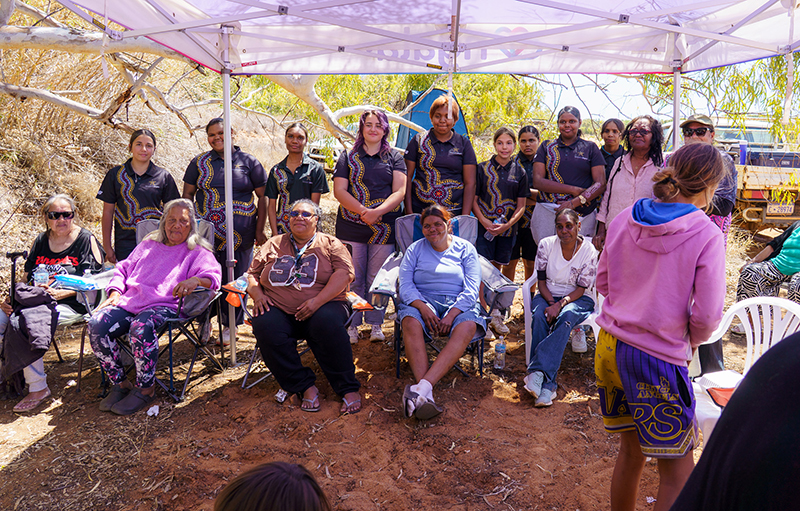
At lunchtime, the group moved into the Gascoyne riverbed near the old reserve. Women were ferried in by 4WD, which added a sense of adventure and helped shift the energy from “meeting” to “gathering on Country”. Locals Naomi McMahon and Tate Barker cooked kangaroo tail in the coals, sharing traditional food in a setting that felt deeply local and familiar. Young leaders from Carnarvon Community College joined the group in the riverbed, deepening the conversation and creating space for elders to share stories, encouragement and advice with the next generation.
The combination of a formal morning session and an on‑Country yarning circle meant the day could hold both structure and warmth – a place where serious issues could be named, and where women could connect, laugh, eat together and feel strong in culture.
What women spoke about
Across the day, women spoke about:
- Culture, healing and identity – the importance of being on Country, family gatherings, storytelling and yarning, women’s and elders’ gatherings, bush medicine, traditional foods, and keeping language and stories alive.
- Pride and survival – what it means to be an Aboriginal woman in the Gascoyne, to belong to the world’s oldest living culture, and to keep going despite the impacts of colonisation, discrimination and trauma.
- Family, safety and wellbeing – the pressures on women as carers, the effects of alcohol and drugs, mental health challenges, and the need for more healing‑focused, culturally safe supports for women, children and elders.
- Everyday pressures and priorities – the rising cost of living, housing, access to respectful and responsive services, and what would make daily life easier and safer for women and their families.
- Opportunities for work and training – what kinds of jobs and training women want access to, the barriers they face in taking them up, and how local employers and training providers could do better in supporting Aboriginal women into secure, culturally safe work.
The feedback made it clear that Aboriginal women in the Gascoyne hold deep insight not only into the challenges facing the region, but into practical, grounded solutions.
Why this forum mattered
One of the most important outcomes of the forum was that it created a genuine platform for Aboriginal women’s voices to be heard in places where they have too often been missing. Through the partnership with the RRR Network, the feedback from Gascoyne women was used to inform the annual RRR report, helping ensure that policy conversations include Aboriginal women’s lived experiences and priorities, not just those of the broader regional population.
At the same time, the forum had direct local impact. The insights and themes gathered through the day were used to inform Carnarvon Common Ground’s broader community engagement and fed into the development of the CCG strategic framework and community‑agreed priority actions. In that sense, the forum strengthened both external advocacy and local planning: it helped take Gascoyne Aboriginal women’s voices outward to policy makers, and inward into the shaping of Carnarvon’s own community‑led agenda.
Why it is now annual
The strength of the conversations, the depth of the feedback and the clear value of having a space designed specifically for Aboriginal women showed that this could not be a one‑off event. The forum created connection, surfaced priorities that might not have emerged in other settings, and demonstrated how much insight Aboriginal women are ready to share when the setting is culturally safe, grounded and genuinely respectful.
That is why the Aboriginal Women’s Forum has now become an annual event. It is not just a gathering; it is an ongoing commitment to making sure Aboriginal women in the Gascoyne have a consistent platform to speak, shape priorities and influence both local action and broader policy conversations.
What this project has achieved
Through this forum, the project has already achieved several important outcomes:
- Created a culturally safe space for Aboriginal women’s voices, across both a structured workshop setting and a yarning circle on Country.
- Strengthened Aboriginal women’s contribution to policy discussions, through direct input into the RRR Network’s annual reporting.
- Informed Carnarvon Common Ground’s own planning, with feedback helping shape the CCG strategic framework and community‑agreed priorities.
- Built a foundation for an ongoing annual event, recognising the importance of hearing consistently from Aboriginal women in the Gascoyne and involving young women alongside elders.
Over time, the Aboriginal Women’s Forum is helping to change the conversation. It is making sure that Aboriginal women’s voices are not treated as an afterthought, but recognised as central to understanding what is needed for stronger families, stronger communities and better policy in the Gascoyne.
If you would like to read the RRR Women’s Survey Report, you can find it: here.